Kat Zet II
The Zone of InterestKat Zet II is the destination at the end of a route from the ramp through the birch wood to the Little Brown Bower: a place where an orderly, almost pastoral setting frames the machinery of mass death. The camp’s geography links selection and transport to a sealed chamber, while its odors, contaminated water, and altered landscape register consequences that the camp’s officials try to treat as ordinary.
Setting and Route
The ramp is the point of arrival and selection. As Boris Eltz explains, its sequence runs from detrainment to selection, then through the birch wood to the Little Brown Bower in Kat Zet II. The route turns movement through the camp into a process: people arrive, are sorted, and are driven onward. Boris is assigned a month of staggered ramp duty as punishment for another fistfight, a punishment that places him inside this routine and gives him a close view of its most eerie stage.
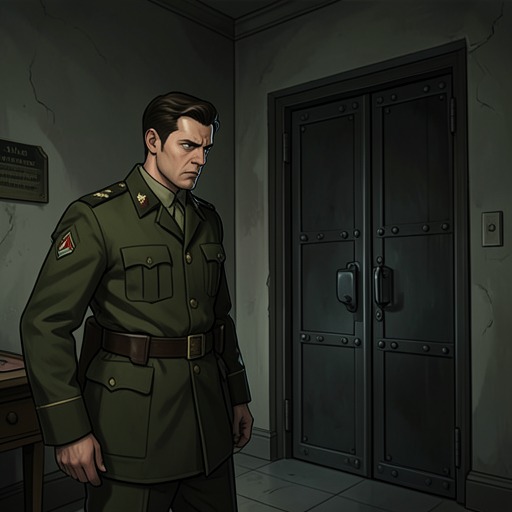
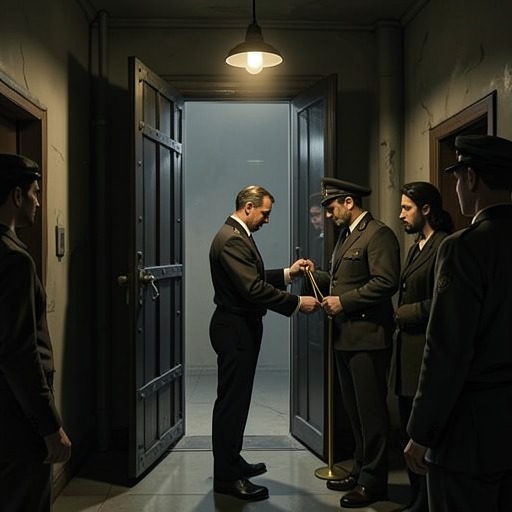
The approach to the Bower is rendered in terms of carefully tended surfaces: peeling birchbark, a picket fence, potted geraniums and marigolds. Beyond them lie the undressing room and the chamber. When Wolfram Prufer gives his signal, Paul Doll turns on his heel, knowing the doors have been screwed shut. The contrast between flowers and locked doors is not incidental decoration; it makes the camp’s violence appear embedded in a landscape arranged to look calm and civilised.
Arrivals and the Killing Process
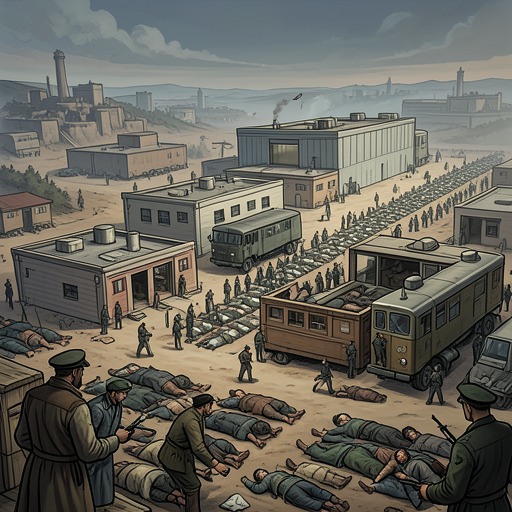
During one arrival, the scene’s apparent welcome is interrupted by a lorry carrying the day’s dead from Kat Zet I to Kat Zet II. The vehicle’s breakdown exposes its cargo for only a few seconds, but that brief glimpse is enough to disrupt the reception. Baldemar Zulz raises his arms as if to ward off the sight, and even Boris turns toward Doll. Doll, by contrast, regards the load as familiar. His practiced response is to signal the musicians: their playing resumes as the lorry clears the crossing, and the group continues walking.
The arrivals are Parisians from a retirement home and an orphanage. They have just witnessed what the camp’s polite reception cannot explain away, yet Doll concludes that they cannot absorb what they have seen. The movement through the birch wood continues, past the Bower and into the sequence of rooms that ends at the sealed chamber. The setting thus stages a collision between what newcomers can see and the administrative composure with which the camp continues its work.
The Industrial Landscape and Its Stench
Kat Zet II belongs to a wider environment shaped by camp labor and industry. From an office at the Buna-Werke, Doll watches striped prisoners moving at a frantic pace, Kapos shouting at them, SS noncommissioned officers shouting at the Kapos, and company foremen shouting at the SS. The figures that hold his attention, however, are the designers, engineers, and administrators from IG Farben plants in Frankfurt, Leverkusen, and Ludwigshafen. Carrying leather-bound notebooks and retractable measuring tapes, they pick their way past wounded, unconscious, and dead people. The passage places technical inspection and industrial administration in the same landscape as bodily injury and death.
The camp’s physical environment also defeats the effort to keep its consequences out of sight or smell. In the Old Town, local officials tell Doll and Wolfram Prufer that the water is undrinkable even after repeated boiling; material in it has begun to ferment, and the water table has been breached. On the drive back, Doll repeatedly pulls over to sniff the air, finding the smell worse each time. His response turns the odor into an image of uncontrolled accumulation: contamination does not remain neatly within a designated place or procedure.
Landscape as Evidence
Later, Doll’s questions gather the camp’s surroundings into a catalogue of consequences: flies as fat as blackberries, vermin and disease, rats exchanged for five bread rations per cob, and snow turned brown. He asks why the meadow was made to churn and spit, and why conception and gestation in this place promise death for both woman and child. The questions do not resolve into an account of responsibility; they expose the gap between the regime’s language of purpose and the material world its actions produce.
Kat Zet II is therefore more than a point on the transport route. Its birch wood and flowerpots, its chamber doors, and the pollution that spreads beyond the camp all belong to one continuous geography. The apparent calm of the setting is repeatedly broken by what it carries, receives, and leaves behind; even the stench becomes a form of evidence against the orderly presentation of the place.